
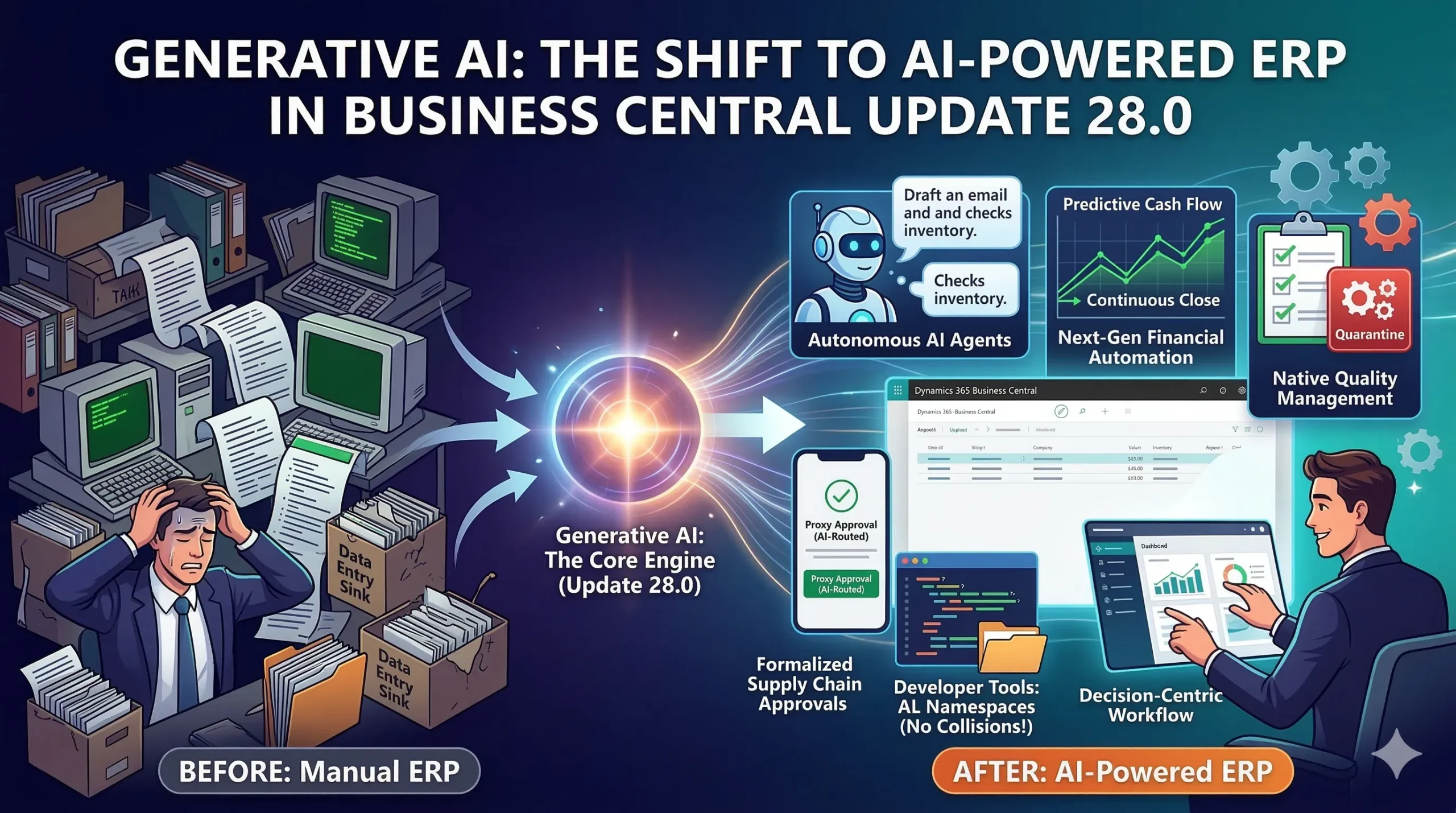
Generative AI: The Shift to AI-Powered ERP in Business Central Update 28.0
Generative AI is no longer a futuristic buzzword or a novelty chat tool; it is the core engine powering the highly anticipated Dynamics 365 Business Central 2026 Release Wave 1 (Update 28.0). If you have spent any significant amount of time managing operations, balancing financial ledgers, or hunting down inventory discrepancies, you already know the traditional enterprise resource planning grind. Historically, ERP systems have been massive data entry sinks. You poured numbers in, navigated through a labyrinth of menus, and maybe—just maybe—you pulled a useful report out in time for your monthly meetings. It often felt like you were working for the software, rather than the software working for you.
Update 28.0 flips that dynamic entirely on its head. This upcoming release represents a massive paradigm shift. Microsoft is not just slapping a smart search bar onto a legacy database. Instead, they are completely rebuilding how users interact with their business data. Industry insiders and beta testers are already calling this the dawn of a new era in ERP, where deep automation and highly capable intelligent agents take over the heavy lifting. By shifting the platform’s focus from mere data storage to proactive problem-solving, your team can finally step away from the keyboard and focus on actual strategic decision-making.
The Dawn of a New Era in ERP
For years, businesses have asked for smarter software, but the jump from “automated rules” to true intelligence always felt out of reach. We relied on rigid workflows. If X happens, then Y is triggered. The problem with rigid workflows is that real-world businesses are rarely rigid. Exceptions happen every single day. Shipments are delayed, vendors change pricing without notice, and raw materials fail quality checks.
The 2026 Release Wave 1 completely redefines how a business management system handles these exceptions. The sentiment surrounding this release is overwhelmingly positive because it addresses the human element of operations: burnout. By weaving AI directly into the fabric of the software, Business Central is transitioning from a passive ledger into an active participant in your daily operations. This is what we mean when we talk about decision-centric workflows. Instead of presenting you with a list of tasks to complete, the system presents you with decisions to make, having already completed the underlying legwork.
Why AI is No Longer Just an Add-On
In previous updates, artificial intelligence often felt like an optional feature—a neat trick for drafting customer emails or generating basic marketing text. In Update 28.0, Generative AI is a foundational pillar of the platform architecture. It is no longer an add-on you occasionally use; it is the underlying mechanism that drives the new user experience.
This integration means that the system understands the context of your data. It knows the difference between a routine inventory top-up and a critical supply chain shortage that threatens a key client’s order. When AI is built into the core, it doesn’t just read the data; it interprets the intent behind your business processes, drastically reducing the friction that typically slows down daily operations.
Core Features of Dynamics 365 Business Central Update 28.0
Let’s dive into the specifics of what makes the 2026 Release Wave 1 so transformational. From sweeping operational overhauls to highly specific developer tools, this update leaves virtually no stone unturned.
Generative AI Agents Taking Center Stage
Perhaps the most exciting development in Update 28.0 is the introduction of autonomous generative AI agents. Think of these agents as digital co-workers who operate in the background. Unlike a standard Copilot interface where you must prompt the system for answers, these agents can be configured to monitor specific business conditions and take action autonomously.
Imagine a scenario where a critical supplier unexpectedly delays a shipment of raw materials. In a traditional ERP, you wouldn’t know there was a problem until your production floor ground to a halt or a purchasing manager noticed a past-due purchase order. With native AI agents, Business Central instantly flags the delay, cross-references your current inventory, identifies the production orders that will be impacted, and automatically drafts an email to the affected customers. It can even suggest alternative suppliers who have the materials in stock and prepare the new purchase orders for your final approval. This level of proactive management saves countless hours and prevents minor hiccups from cascading into massive operational failures.
Next-Generation Financial Automation
Finance teams are intimately familiar with the dread of the month-end close. It is a time-consuming ritual of reconciling accounts, chasing down missing invoices, and correcting data entry errors. Update 28.0 introduces next-generation financial automation designed to make the continuous close a reality.
The system now utilizes advanced pattern recognition to auto-reconcile bank statements with a much higher degree of accuracy than traditional rule-based matching. Furthermore, predictive cash flow forecasting has been significantly enhanced. Instead of relying purely on historical data, the AI analyzes vendor payment behaviors, seasonal trends, and current market conditions to give you a highly realistic picture of your liquidity. If an expense anomaly is detected—such as a sudden spike in software subscription costs or unusual travel expenses—the system automatically tags the entry and alerts the controller, ensuring that nothing slips through the cracks.
Native Quality Management Capabilities
For manufacturers and distributors, quality control has historically been a fragmented process within Business Central, often requiring expensive third-party ISV (Independent Software Vendor) add-ons to function properly. Update 28.0 changes the game by introducing robust, native quality management capabilities directly into the core application.
Users can now establish complex inspection plans, set sampling rates based on vendor performance history, and track defect metrics in real-time. If a batch of products fails an inspection on the shop floor, the system can automatically place the inventory into quarantine, initiate a vendor return process, and update the production schedule to account for the lost materials. By tying quality metrics directly to supply chain and production data, businesses can finally maintain a holistic view of their product integrity without relying on disconnected spreadsheets.
Formalized Supply Chain Approvals
Procurement is another area receiving a massive upgrade. Anyone who has ever tried to track down a purchase approval through a messy chain of forwarded emails will appreciate the new formalized supply chain approvals.
Update 28.0 introduces deeply customizable, multi-tier approval workflows that natively integrate with Microsoft Teams and Outlook. You can establish conditional routing based on vendor type, purchase amount, or specific item categories. The true magic, however, happens when AI is applied to these workflows. If a manager is out of the office, the system can intelligently route the approval to a designated proxy based on the urgency of the order. Furthermore, the system can analyze the requested purchase against budget constraints and historical pricing, providing the approver with an instant summary of whether the transaction is sound, saving them from having to dig through past ledger entries.
Crucial Platform Enhancements for Developers
While front-end users have plenty to celebrate, Microsoft has not forgotten the developers and partners who build and maintain the Business Central ecosystem. The 2026 Release Wave 1 includes critical architectural upgrades that make customizing the system more stable and efficient.
The Introduction of AL Namespaces
For the technical crowd, the most significant platform enhancement is the official introduction of AL namespaces. In the past, Business Central developers coding in Application Language (AL) had to rely on prefixes or suffixes to prevent naming collisions between different extensions. If two different developers created a table named “Commission,” the entire system could crash during an update.
With AL namespaces, developers can finally group their code logically, exactly as they do in modern programming languages like C# or Java. This seemingly minor technical adjustment is a massive leap forward for platform stability. It allows larger development teams to collaborate without stepping on each other’s toes, heavily reduces technical debt, and ensures that when businesses install multiple ISV solutions, those extensions will play nicely together without catastrophic code clashes.
How Deep Automation Reinvents Daily Workflows
It is easy to get lost in the technical features, but the true value of Update 28.0 lies in how it makes your employees feel at the end of the day. Modern work is exhausting, and much of that exhaustion comes from wrestling with uncooperative software.
Eradicating Mundane Tasks
By leveraging Generative AI, Business Central essentially strips away the mundane. Data entry clerks no longer need to manually transcribe PDF invoices into the system; the built-in optical character recognition, backed by AI comprehension, reads the document, understands the line items, and creates the purchase invoice automatically. Customer service representatives no longer need to spend twenty minutes investigating an order status; they can simply ask the system in natural language, “Where is the Anderson shipment?” and receive a complete, human-readable summary of the entire logistics chain.
Empowering Decision-Centric Workflows
When you remove the busywork, what is left? Strategy. Update 28.0 enables decision-centric workflows by curating data and presenting actionable choices. A warehouse manager isn’t just told that inventory is low; they are presented with three distinct replenishment strategies, complete with cost analysis and delivery timelines. The manager simply clicks “Approve” on the best option. The human remains firmly in the driver’s seat, but the ERP acts as a hyper-efficient navigator.
Preparing Your Business for the 2026 Release Wave 1
With a release this substantial, preparation is critical. You cannot simply flip a switch and expect your organization to instantly adapt to AI-driven workflows.
First, you need to assess your technical readiness. With the new AL namespaces and architectural changes, older, heavily customized legacy code may need to be refactored. Work with your implementation partner now to review your existing extensions and ensure they are compatible with the new structure.
Second, focus on user adoption. The shift from task-based work to decision-based work requires a cultural change. Train your employees not just on where the new buttons are, but on how to trust and verify the AI recommendations. Encourage them to experiment with the natural language prompts and Copilot features in a sandbox environment before the update goes live.
Conclusion
The Dynamics 365 Business Central 2026 Release Wave 1 is not just another routine software update; it is a fundamental reimagining of what business management software should be. By placing Generative AI at the very core of the platform, introducing native quality management, and delivering robust developer tools, Microsoft is setting a new industry standard. Update 28.0 promises to reduce the friction of daily operations, eliminate mundane data entry, and empower your team to focus on the strategic decisions that actually drive growth. The shift to an AI-powered ERP is here, and it is time to get your business ready for the ride.
I appreciate the effort that goes into creating high-quality content, and this post was no exception. The insights and information were top-notch and made for a really engaging read. Keep up the great work!
Your blog has become a part of my daily routine Your words have a way of brightening up my day and lifting my spirits
unlocker.ai – The Ultimate AI Tool for Bypassing Restrictions and Unlocking Content Seamlessly!
Bài chia sẻ chất lượng. Ai đang tìm hiểu du học Hàn Quốc có thể liên hệ Letco — hỗ trợ chọn ngành, học bổng và thủ tục visa nhanh gọn. Chi tiết ở letco.vn.